All published articles of this journal are available on ScienceDirect.

Walkability in European Cities from a Tourist Perspective: A Comparative Study of Thessaloniki and Lyon using Choice-based Conjoint Analysis
 iD
Léo Leroy3 , 4
iD
Vladislav Maraš5
iD
Eleni Anoyrkati6
iD
iD
Léo Leroy3 , 4
iD
Vladislav Maraš5
iD
Eleni Anoyrkati6
iD
Authors Info & Affiliations
Abstract
Introduction
Walking is a core component of urban mobility and constitutes the first and last mile of most urban trips, particularly for tourists navigating unfamiliar cities. Understanding how visitors perceive walkability and which pedestrian infrastructure attributes most influence their walking choices is essential for improving pedestrian mobility in urban environments.
Materials and Methods
The study uses Choice-Based Conjoint (CBC) analysis based on street-intercept surveys conducted in the summer of 2021 in two European cities with contrasting urban and mobility characteristics: Thessaloniki (Greece) and Lyon (France). A total of 163 valid questionnaires were collected (78 in Thessaloniki and 85 in Lyon). Five (5) walkability attributes were evaluated: viz. i) proximity to public transport stops, ii) road-crossing facilities and safety, iii) green elements in streets and public spaces, iv) weather protection, and v) sidewalk obstacles.
Results
The results reveal clear differences between the two cities. In Thessaloniki, green elements in streets and public spaces are the most influential attribute (31.15%), followed by proximity to public transport (18.56%) and road-crossing equipment and safety (17.86%). In Lyon, road-crossing equipment and safety ranks highest (22.22%), followed by proximity to public transport (21.18%) and green elements (20.65%). In both cities, proximity to public transport consistently emerged among the top priorities.
Discussion
The findings indicate that while certain walkability priorities, such as safe crossings and access to public transport, are transferable across European cities, others are strongly context-dependent. Climatic conditions, urban form, and existing transport infrastructure appear to shape tourists’ walking preferences differently across cities.
Conclusion
This study provides evidence-based insights for pedestrian mobility planning and sustainable urban mobility policy. By identifying and ranking design-actionable walkability attributes from a tourist perspective, it supports place-sensitive interventions aimed at improving pedestrian environments along urban tourist corridors.
1. INTRODUCTION
1.1. Scope and the Importance of Walking
In this paper, a comparative study of tourists’ perceptions of walkability in Thessaloniki (Greece) and Lyon (France) using Choice-Based Conjoint (CBC) analysis is presented. The objectives and research questions are explicitly stated at the end of the introduction.
Both cities have European-wide ambitions and attract approximately 1.5 million and 5 million visitors per year, respectively (pre-COVID levels). Still, they also differ in history, geography, economy, transportation, and culture. Through extensive desk research and qualitative studies in Thessaloniki and Lyon, we identified walkability parameters, enabling us to understand tourists’ expectations and needs.
Walking is the oldest mode of transport. Humans require only their bodies to walk; they can travel anywhere, at any time, and at a pace of their choosing. Therefore, this mode of transport has a specific degree of freedom, restrained only by the limits of the human body. The arrival of new modes of transportation gradually replaced walking in society, cities, and people’s lives. Walking, as a mode of transport, gradually lost its importance. As public awareness of environmental issues has grown, walking and active mobility have regained importance, which is why we can see many cities designing recent projects around walking, e.g., pedestrian-oriented urban interventions, such as the pedestrianization of the banks of the Seine in Paris and the Rhône riverfront in Lyon [1].
Recent literature on walkability reveals a growing interest in how urban environments support or hinder pedestrian activity across settings ranging from historic cities to modern urban centers. Develey (2012) [2] and Ramirez (2018) [3] used annotated walking tours and multicriteria evaluation frameworks in Swiss cities to assess walkability from the pedestrian’s perspective. Their results reveal major gaps between pedestrian needs and the qualities of the built environment, highlighting the need for user-informed design that responds to specific contexts. Similarly, Granié and Auberlet (2008) [4] provide a detailed examination of how pedestrians interact with their environment. They examine infrastructure and accessibility, as well as the psychosocial adaptations pedestrians must make while traversing intricate metropolitan environments.
Research examining impressions from both locals and tourists underscores the subjective dimensions of walkability. Gkavra et al. (2019) [5] examine Thessaloniki and uncover operational deficiencies in both suburban and urban center regions. Residents identify safety, beauty, and accessibility as their foremost concerns. Boulmou et al. (2023) [6] contribute to this discourse by assessing walkability in Veroia and Igoumenitsa, Greece, and identifying actionable enhancements, such as wider sidewalks, improved lighting, and stricter enforcement of illegal parking. Noraffendi and Rahman (2020) [7] demonstrate that tourists' satisfaction with Georgetown's pedestrian infrastructure does not meet their expectations, revealing a disparity between the available amenities and user experiences in historical tourism.
Collectively, these studies indicate that walkability encompasses more than mere physical infrastructure. Walkability is a multifaceted topic influenced by spatial design, perceived safety, environmental aesthetics, and human behavior.
Recent research emphasizes that understanding tourists’ actual walking behaviors, rather than self-reported preferences, is crucial for developing more sustainable destinations. Confente et al. (2024) [8] present an innovative methodology that employs both structured and unstructured big data to analyze and evaluate tourists’ mobility patterns in cities such as Verona, allowing destination managers to discern sustainable behaviors, including dispersal from congested areas and interaction with local culture. Their findings underscore the importance of monitoring actual tourist movements, rather than merely intended ones, in guiding sustainable tourism policies. This renewed policy focus on active mobility was also reinforced during the COVID-19 period, when many European cities implemented temporary and permanent walking- and cycling-related measures to rebalance street space and support safer urban movement [9]. Nevertheless, completely rebuilding a city for pedestrians is impossible and irrelevant. Instead of reconstructing Thessaloniki or Lyon, it makes more sense to examine these cities and their current pedestrian facilities, including pedestrian lanes, pavements, pedestrian crossings, squares, and other areas designed primarily for pedestrians [10].
In this paper, the factors influencing walking in the cities of Thessaloniki and Lyon are investigated to determine how to promote walking in both cities. According to Hall (1966) [11], architects and city planners will only avoid disaster if they consider man as an interlocutor with his environment. Space users are useful actors in its creation and development. Therefore, the study adopts an interdisciplinary perspective, drawing on insights from anthropology, sociology, and urban planning to examine tourists’ perceptions of walkability. We chose tourists because this population is foreign to the study site, unfamiliar with it, and has different expectations and needs compared to the city’s inhabitants. Indeed, this choice does not allow us to study the daily journeys all inhabitants make between their homes and their workplaces (i.e., commuting), which is the main reason for traveling in a city. However, it will allow us to study leisure trips, including visits or revisits to a city. We will therefore attempt to identify, from a tourist’s perspective, the parameters that encourage walking in Thessaloniki and Lyon. We will first examine walking in cities, including walkability and its influencing factors.
1.2. Recent Research
Recent studies on travelers’ mobility patterns and preferences have revealed numerous important findings. Tourists typically like private vehicles for their flexibility and comfort.
Nevertheless, younger individuals exhibit a greater propensity to utilize non-motorized and shared transportation modes [12, 13]. Travel preparation markedly affects mobility patterns. Well-prepared visitors participate in a broader array of activities [14]. Happiness significantly influences tourist experiences and mobility decisions [15]. Analysis of mobile phone data elucidates multiple facets of tourist movement, encompassing duration of stay, spatial range, and activity diversity [16]. Artificial intelligence techniques applied to social media data can discern unique mobility patterns among tourist groups [17]. The importance of tourist resources and the prominence of metropolitan areas influence visitor mobility and destination selection [18]. Understanding these trends is crucial for formulating sustainable tourism policies and enhancing visitor experiences [19].
Recent sociological and geographical research on walkability emphasizes its various dimensions, encompassing physical, social, and perceptual aspects. Walkability is associated with improved public health, sustainability, and economic development [20]. Research underscores the need to address diverse people and their specific needs when designing walkable spaces [21]. The concept of the “walking assemblage” explores the influence of social and material variables on walking behavior [22]. Individuals residing in highly walkable neighborhoods walk more, especially those who favor non-motorized transportation [23]. Social attributes, a sense of community, and pleasure are recognized as essential elements that facilitate walking [24]. Researchers contend that enhancing walkability necessitates not only superior physical infrastructure but also an emphasis on social norms, personal attitudes, and individual skills [25, 26].
The design and planning of pedestrian environments have recently garnered heightened attention due to the advantages of walkability for health, sustainability, and social equality [27, 28]. Essential elements encompass comprehending pedestrian behavior, analyzing settings, and simulating pedestrian flows [29]. Effective pedestrian networks require connectivity, safety, and high-quality pathways. Planning methodologies entail evaluating walkability conditions and modifying guidelines [27]. Research has broadened to encompass pedestrians’ perceptions, comfort levels, and exploration of urban areas [30].
Recent studies of tourist mobility indicate that visitors’ movements cluster around identifiable cores and corridors, shaped by attractions, network structure, and micro-scale design features. Early Global Positioning System (GPS) tracking and later app-based analyses highlighted how perceived safety, shade/thermal comfort, and wayfinding legibility steer walking versus micromobility and public transport, and how time–space budgets compress exploration in unfamiliar cities [27, 30, 31]. In practice, tourist walking forms part of an intermodal chain; crossing quality/safety and proximity to public transport often anchor short-stay itineraries [30, 31].
Accessibility, understood as the ease of reaching opportunities, links urban form to behavior through land-use distributions, transport impedance, temporal constraints, and individual needs [32, 33]. At the pedestrian scale, crossing equipment and signalization reduce perceived risk and time penalties; proximity to public transport stops expands the reachable opportunity set within limited tourist time budgets; green/shade extends comfortable walking range in warmer climates; and sidewalk obstacles introduce friction that narrows feasible choices [30, 31, 34]. For short-term visitors who rely on immediate cues rather than local knowledge, these micro-elements often dominate over broader land-use metrics [30, 31]. Meta-analytic evidence also links destination accessibility and street network design to travel choices, underscoring the salience of these factors for pedestrian decision-making [35].
Because planners must prioritize among observable, design-actionable attributes under budget and space constraints, a CBC design is appropriate: it isolates the marginal contribution of each attribute, quantifies compensations/trade-offs, and supports between-city comparisons by holding the attribute set constant [30, 31, 34]. This yields design-ready, context-sensitive evidence for Thessaloniki and Lyon.
Recent research has examined walkability and pedestrian behavior from multiple methodological perspectives. Empirical modeling studies have investigated route choice and perceived walkability using both Revealed Preference (RP) and Stated Preference (SP) approaches, emphasizing built-environment attributes such as greenery, connectivity, frontage activation, and weather protection [35-37]. Broader reviews have synthesized the influence of density, land use, safety, and environmental quality on walkability outcomes [38]. Climate-sensitive pedestrian behavior has also received growing attention, particularly regarding shade preference and thermal regulation in hot urban contexts [39].
Within tourism research, discrete choice and conjoint methods have been widely applied to destination and accessibility attributes, including redevelopment preferences, cultural features, and transport connectivity [40-43]. Studies linking tourism and walkability have often relied on aggregate indices rather than individual-level trade-off modeling [44], while conjoint applications in urban environmental contexts have primarily focused on specific design elements such as urban forests or sidewalk infrastructure [45, 46].
As shown in Table 1, existing studies have examined walkability determinants, pedestrian route choice, and tourism-related preferences using observational, stated-preference, and conjoint methods. Nevertheless, most focus on resident populations, aggregate indices, simulated environments, or single-city cases. The application of CBC modeling to assess tourist preferences for street-level walkability attributes within a comparative cross-climatic urban framework remains limited. The present study addresses this gap by integrating CBC modeling with a field-based survey design across two distinct European urban contexts.
| Study | Context | Method | Main Focus | Limitation / Gap |
|---|---|---|---|---|
| Neuts & Vanneste (2020) [40] | Amsterdam (tourism development) | Discrete Choice Experiment (DCE) | Resident preferences for green areas & commercial mix | Not tourist-focused; not walkability-specific; single-city case |
| Erath et al. (2015) [36] | Singapore (urban pedestrian routes) | RP & SP modeling | Route choice is influenced by greenery, frontage, traffic separation, and weather protection | Not tourist-focused; no conjoint/CBC modeling; single-city case |
| Masiero & Hrankai (2022) [42] | Tourist accessibility to peripheral attractions | DCE | Tourist preferences for accessibility & transport connectivity | Not walkability-specific; no street-level pedestrian attributes; no cross-city comparison |
| Lee et al. (2016) [41] | Seoul (tourism destination) | Choice experiment | Tourist preferences for cultural destination attributes | Not walkability-specific; no pedestrian environment attributes; single-city case |
| Choi et al. (2025) [43] | Yacht tourism | Conjoint analysis | Tourist preferences for service and safety attributes | Not walkability-specific; no urban pedestrian focus |
| Liao et al. (2022) [37] | Virtual urban environments | Conjoint experiment | Effects of land use, connectivity, and greenery on walkability perception | Not tourist-focused; simulated experimental setting; no cross-city comparison |
| Hall & Ram (2019) [44] | England (tourist attractions) | Walk Score index analysis | Relationship between walkability and visitation | No SP modeling; no attribute-level trade-offs; aggregate-level analysis |
| Andrade et al. (2015) [45] | Washington DC (urban forests) | Conjoint analysis | Preferences for vegetation and forest attributes | Not walkability-specific; not tourist-focused; single attribute domain |
| Fonseca et al. (2021) [38] | Multi-city (systematic review) | Literature review | Built-environment determinants of walkability | No SP modeling; no attribute-level trade-offs; not tourist-focused |
| Anyfanti et al. (2025) [46] | Sidewalk design preferences | CBC | Sidewalk attributes: accessibility, shading, width, air temperature reduction, aesthetics | Not tourist-focused; single-city case |
| Melnikov et al. (2023) [39] | Hot urban environments | Experimental behavioral study | Shade preference and thermal regulation in pedestrian path choice | No conjoint/CBC modeling; not tourist-focused; single-climate context |
1.3. Rationale for the Comparative Case Study
The choice of Thessaloniki and Lyon as case study cities is both methodological and contextual. From a scientific perspective, both cities are major urban centers with comparable demographic scales and tourism intensity, sharing a strong heritage-based tourism profile and dense historical cores. They also present similar topographical constraints (e.g., hilly terrain), while differing substantially in public transport systems, levels of green infrastructure, and climatic conditions. These convergences and divergences create a suitable framework for controlled comparison.
Since Conjoint Analysis is inherently context-sensitive, applying it across two structurally comparable but distinct cities enables the identification of transferable design priorities while respecting locality-specific perceptions of walkability. The selection was therefore guided by three criteria: (i) comparable urban scale and tourism intensity, (ii) similar historical and heritage-based tourism profiles, and (iii) contrasting climatic and microclimatic conditions influencing pedestrian comfort. This combination allows urban structure to remain broadly aligned while environmental conditions vary sufficiently to test context sensitivity in tourists’ walkability preferences.
Field access to both cities facilitated consistent data collection across comparable tourist populations.
1.4. Walking in the City
Throughout history, most civilizations have made walking central to their communities and have shaped them spatially accordingly. However, in recent centuries, walking has been largely abandoned in favor of newer, faster modes of transportation, allowing long journeys to be completed more quickly. The first change was brought about by the domestication of the horse, which enabled humans to accompany them on foot to carry heavy loads and, later, to ride them. Later, due to the development of specialized technologies, horse-drawn vehicles enabled the transport of several people. Later, in the 19th century, the steam engine and the appearance of the first locomotives enabled the development of rail and sea transport. However, at that time, their use was still primarily limited to transporting goods, and it was only in the second half of this century that transport companies began to open up to the general public. During the following century, air transport experienced rapid development and greater accessibility for tourism, enabling travelers to reach any part of the world in record time. During the same period, the growth and spread of the private car allowed everyone to move freely around cities, alone or in groups, with the only constraint being the lack of roads.
In the city, walking is often opposed to many modes of transportation, such as private cars, taxis, soft mobility (bicycles, skateboards, manual or electric scooters), light motorized vehicles (motorbikes and scooters), and public transportation. However, walking is a component of every journey, regardless of the mode of transport used. With a soft mobility vehicle, walking can be minimized, as such vehicles allow for easier mounting and use compared with cars or motorbikes. Nevertheless, the last few meters still need to be covered on foot. This is even more the case when using public transport, which typically only brings passengers close to their destination, requiring the final segment of the trip to be completed on foot.
Walking is not systematically used as an alternative to other modes of transport because walking is not fast enough. Walking allows one to move at approximately 6 km/h (1.6 m/s), which is relatively slow compared to other modes of travel in the city. Walking is therefore slower than other means of transport for long journeys, which is one of its disadvantages. In contrast, for short distances, walking can be much more attractive than other means, due to advantages such as reducing parking delays, particularly during periods of heavy congestion. Therefore, it is possible that in the future, cities will combine several modes of transport to strike a balance among pleasure, simplicity, and speed. Moreover, in these cities with intermodal travel, walking will have its place, as it offers many advantages.
Walking is the universal first and last mile of urban trips. For short-stay visitors, whether they choose to walk between attractions depends less on generic arguments and more on micro-scale, design-actionable features that shape perceived safety, comfort, and legibility: marked/signalized crossings, nearby public-transport access, continuous, obstacle-free walkways, and thermal/weather comfort (e.g., shade, arcades, shelters).
These elements are directly controllable through urban design and management and determine when walking is preferred over micromobility or transit for short urban journeys. Therefore, cities should develop or redesign spaces that actively encourage pedestrian use, given that, according to the World Health Organization [47], this helps prevent non-communicable diseases such as cancer, diabetes, and cardiovascular diseases. Walking is also beneficial for the mind: the effort helps to combat depression and psychological fatigue.
To create the best possible walking conditions, it is not enough to establish pedestrian-only lanes and parks; it is also essential to consider pedestrians’ and potential users’ expectations, such as tourists invited to use the walking infrastructure. Many times, in history, cities have tried to promote walking in the city with very substantial development plans, but without any convincing results, like some of Victor Gruen’s plans in the United States in the 1950s and 1960s, where the aim was to make city centers pedestrian-friendly, with lanes reserved for pedestrians and futuristic developments such as skyways: footbridges suspended between two buildings. However, the results were mixed, and in some cases, cars occupied these spaces. These spaces were perceived as underutilized, potentially reducing their attractiveness for users. This example illustrates the limitations of top-down pedestrian planning approaches that do not sufficiently account for user experience.
Nevertheless, a successful recent example of integrating walkability, greenery, and reduced traffic is the Barcelona Superblocks. By reclaiming inner streets for pedestrians and cyclists, adding urban greenery, and limiting vehicular access, these Superblocks improved air quality and the usability of public spaces. Their implementation illustrates how a strategic, integrated planning model can serve both residents and tourists, encouraging slower, healthier, and more sustainable urban mobility [48].
This study aims to identify the most favorable walking conditions for individuals unfamiliar with a given area, specifically tourists.
1.5. The Most Important Attributes of Walkability
Walkability, defined as a space’s ability to allow and encourage pedestrian use, depends on many factors. These vary in influence depending on the users and the walk’s purpose: an older adult shopping will have different needs than a teenager walking alone at night or a worker commuting to work daily.
1.5.1. Accessibility and Connectivity
Pedestrian accessibility refers to the ease of access for pedestrians in a place, neighborhood, or area. This differs from connectivity, which is the ability to reach that place by any transport, whether by car, public transport, train, or bicycle. These two points highlight the connection between an area and its surrounding spatial environment. The more accessible a place is, the more likely it is to be visited and explored. A difficult-to-access place is often overlooked by tourists, especially those without a private vehicle.
For private vehicle users, mainly cars, scooters, and bicycles, safe and easily accessible parking spaces should be considered. For public transport users, it is essential to ensure they arrive at the target location efficiently, with timetables that facilitate their arrival and return from the site.
The streets must be designed for everyone to access the space they want. People with Disabilities (PwD) (e.g., wheelchair users) need a wide enough path to move freely. It is also important to be able to avoid stairs. In addition, visually impaired pedestrians need an environment with fixed and legible cues, such as clearly delineated sidewalks and pedestrian crossings, rather than shared-space layouts without clear pedestrian guidance.
1.5.2. Tediousness of Walking
Walking may be considered the easiest way to get around town, but it is not always the fastest or least tiring. The difficulty of a path is a crucial factor, as it affects a pedestrian’s psychological and physical fatigue. Individuals are accustomed to different urban forms, and for some population groups, a straight path is unpleasant because it does not allow quick linking between two amenities. A different plan would be more easily disorienting and misleading for someone used to a Hippodamian city. As Hall argues, people interpret and navigate space through culturally conditioned spatial conventions [11]. This helps explain why unfamiliar urban environments may be more difficult for tourists to read and navigate. It can, therefore, be very challenging for a person to navigate an unfamiliar city.
In cities, many spatial breaks divert pedestrians from their direct path. These deviations can be natural, such as landforms or waterways. On hills, in most cities, streets are designed to have the smallest possible slope, even if it means extending the road at the top. These roads prioritize cars, but the routes for pedestrians become longer. Their route is far from straight if they do not find a staircase. In addition to the longer journey due to the constant bends, the hills are tiring to climb. Thessaloniki and Lyon are hilly cities, where the difficulty of walking uphill is evident among individuals who are not accustomed to physical exercise. This discontinuity can also be attributed to the planning choices of the location, including buildings, roads, railways, or facilities. Barriers can hinder movement, forcing pedestrians to take a detour. For example, this is the case when entering most of Lyon’s parks: Gerland, the Tête d’Or, the Parc des Hauteurs, and many others. To enter these parks, one must access them through the gates during opening hours. This sometimes means making detours to enter or leave the park. In contrast, most parks in Thessaloniki are open at all hours and rarely have designated entry points.
More subtly, the pathways of a square can be contrary to the natural route users wish to take. Initially designed for their aesthetic qualities or uses, squares and their paths can be repurposed. When the designed path does not align with users’ expectations, lines of desire can emerge. Figure 1 depicts a “desire path” in a Thessaloniki park, illustrating how pedestrians often create informal shortcuts that differ from the designed circulation. Such behavior reflects a mismatch between planned and actual pedestrian movement patterns, an important element for assessing walkability. These improvised paths appear on a lawn that is too heavily trodden by pedestrians seeking to save time and who do not follow designated routes.
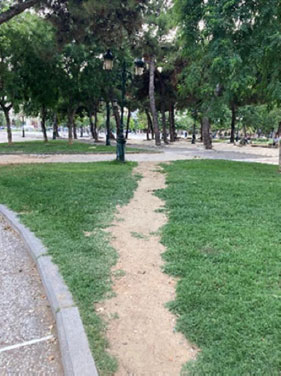
Desire path in the new waterfront park in Thessaloniki.
Moreover, the route’s difficulty can be similar to the difficulty of a short discontinuity in the itinerary. Deviating from or interrupting one’s trajectory to avoid obstacles is often difficult. Obstacles such as parked scooters, bins, or uneven paving can reduce pedestrian comfort and accessibility, especially for PwD or tourists unfamiliar with the urban layout. Figure 2, taken in Thessaloniki, exemplifies how such hindrances force detours and slow movement.
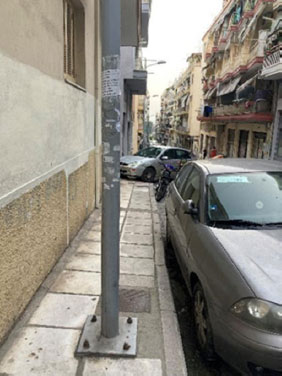
Sidewalk obstruction in the Ano Poli district, Thessaloniki.
1.5.3. Sensory Experience
During our research in Thessaloniki, we noticed that some streets were not suitable for walking in heavy rain. Pedestrians took refuge in the halls of buildings and the entrances of restaurants and shops until the rain subsided. The heat and sunshine can discourage tourists and pedestrians alike from going out at certain times. As seen in many Mediterranean countries, businesses and residents are less active during the hottest hours of the day in the summer months. Weather constraints such as rain, wind, snow, and low or high temperatures are not real problems inside a car, train, bus, tram, or metro. In a car, a simple action activates the windscreen wipers, closes the windows, and starts the air conditioning, thereby resolving the issue. On foot, however, and for two-wheeled vehicles as well, these problems persist regardless of the actions taken. The surrounding environment can provide protection, and some cities are designed to accommodate this more effectively than others. Elements such as trees, buildings, roofs, canopies, and indoor spaces can shelter pedestrians from weather conditions. A city without pedestrian protection from sun, rain, and snow prevents people from walking freely and comfortably year-round.
1.5.4. Green Elements in the Street and Places
Trees and shrubs protect against the weather, cool the area, block the wind, and make the space more attractive in the summer and throughout the year. In hot weather and direct sunlight, artificial equipment can provide shade and reduce exposure. However, the plants in the city help lower the temperature during the day and at night, making the surrounding areas cooler. The control of this high heat is all the more pertinent with the advent of frequent and intense heatwaves associated with global warming. Similarly, plants and green spaces help absorb rainwater, which can hinder movement and pose a risk to the population in extreme cases. Additionally, vegetated areas offer a pleasant and peaceful ambiance. As witnessed after the COVID-19 lockdowns, people gathered in parks not only for the fresh air but also for the calm and aesthetic quality, in contrast to the confinement of living indoors.
1.5.5. Aesthetic Quality of the Environment
The aesthetics of cities attract tourists. However, people have only recently been attracted to urban landscapes. It was in the 19th century that the concept of tourist contemplation and aesthetic pleasure began to emerge among the wealthy majority. However, since then, the city has attracted people not only for its beauty. The aesthetics of a city are also shaped by the activities taking place within it, which can make the urban environment itself more attractive to visitors. It should be noted that these activities are not necessarily artistic; they may include traditions, ways of life, culinary habits, and many other elements, all of which may seem banal to a local but can be striking to a tourist.
Tourists can be drawn to places that offer unique points of interest, such as museums and monuments, or to observe stunning landscapes. In contrast to traditional sightseeing, activities such as shopping, sports, and relaxation attract people. If these activities are spatially concentrated enough, they move from one place to another on foot. Tourists do not always go out with a specific purpose; sometimes they go out to “see the city center” or “see the view.” A district with many monuments attracts tourists to walk around the city, while a residential or industrial district is generally less attractive.
In addition to not attracting pedestrians in general, some less lively areas can make people feel unsafe, which repels pedestrians, especially tourists unfamiliar with the area, who are reluctant to cross through locations that seem dangerous.
1.5.6. Security and Safety
Tourists and residents want to move around peacefully, without risk, as pedestrians, whether due to incivility by various people or to the ever-increasing traffic. The insecurity is fueled by concerns about marginal or infrequent behavior, such as hit-and-run drivers on the roads or the use of electric scooters, which is frightening due to their novelty. The presence of pedestrian crossings and lighting can mitigate this fear.
These crossing facilities make it easy and safe to get around during rush hour and when fewer pedestrians are on the streets, such as at night. Sometimes there are no pedestrian crossings within a reasonable distance, and pedestrians must cross directly into the lane, which is dangerous or can lead to long delays to find a safe opportunity. Moreover, in Thessaloniki, as in many cities, pedestrian crossings are not always clearly marked, which may lead tourists to believe that they do not have priority to cross at a particular location. At the same time, the fear can arise from another pedestrian, who is also a human being and may have malicious intent. Public lighting plays an important role in this area by enhancing perceived safety and visibility; in the event of an incident, it may facilitate timely assistance or intervention. In addition to lighting, the activity and crowd density of the place play major roles in an individual’s perceived safety; proximity to others can enhance perceived security.
Although previous studies have examined walkability determinants, pedestrian route choice, and tourism-related preferences, limited evidence exists on how tourists explicitly trade off street-level walkability attributes under different urban and climatic conditions using a unified experimental framework. This lack of comparative, attribute-level evidence constrains planners’ ability to derive context-sensitive yet transferable pedestrian design priorities. Addressing this gap requires a methodologically consistent, field-based approach that can isolate marginal effects and interactions among key walkability attributes.
1.6. Objectives and Research Questions
This paper aims to quantify how tourists trade off walkability attributes and to derive design-ready, context-sensitive priorities for pedestrian improvements.
The four (4) objectives of the paper are as follows:
1. Estimate part-worth utilities and relative importances for five walkability attributes using a CBC experiment in each city.
2. Compare attribute importances between Thessaloniki and Lyon and test for any differences.
3. Examine trade-offs/interactions among crossing safety, public-transport proximity, green/shade, and sidewalk obstacles.
4. Translate the findings into practical pedestrian design priorities that are transferable to similar European cities while respecting local context.
To operationalize these objectives, the study addresses the following four (4) Research Questions (RQs):
1. RQ1 (Within-city priorities): Which walkability attributes most influence tourists’ route choices in each city?
2. RQ2 (Between-city differences): Which attribute importances differ significantly between Thessaloniki and Lyon, and what urban-context factors plausibly explain the differences?
3. RQ3 (Trade-offs/interactions): How do crossing safety and public-transport proximity interact with green/shade and sidewalk obstacles in shaping perceived walkability?
4. RQ4 (Regional transferability): Which findings are transferable to similar European heritage cities, and which are context-specific?
RQ1–RQ3 are addressed in Methodology (§2) and Results (§3.2). RQ4 is addressed in Discussion (§4) and Conclusions (§5).
1.7. Academic Soundness and Journal Fit
The study applies two parallel, randomized CBC experiments conducted in Thessaloniki (Greece) and Lyon (France). CBC is well-suited to transport research as it isolates marginal effects, quantifies trade-offs among attributes, and supports policy-relevant prioritization. Data quality was ensured through randomized task design and screening for low-quality responses (e.g., straight-lining). The selected attributes are directly observable by tourists, actionable by planners, and comparable across cities, ensuring interpretability and external relevance.
RQ1 is addressed by estimating city-specific relative importances and part-worth utilities, identifying the walkability attributes that most influence tourists’ route choices. RQ2 is addressed through the controlled cross-city comparison enabled by the identical experimental design, allowing systematic identification and interpretation of differences between Thessaloniki and Lyon. RQ3 is addressed by the CBC framework’s ability to reveal compensatory trade-offs across attributes, clarifying how tourists balance safety, accessibility, greenery, comfort, and micro-impedances. RQ4 is examined in the discussion and conclusions by consistently differentiating between important traits and context-dependent ones, thereby facilitating transferability to various European urban and tourism contexts.
The paper is aligned with the Open Transportation Journal by integrating behavioral transport analysis, pedestrian mobility, and urban design ramifications. It enhances comprehension of decision-making regarding non-motorized transportation through a rigorous stated-preference methodology. It converts findings into design-oriented goals for pedestrian and multimodal planning, aligning with the journal’s emphasis on practical, evidence-based transportation research.
2. MATERIALS AND METHODS
The CBC experiment operationalizes the literaturederived attributes and tests their trade-offs within and between the two cities, enabling a comparative assessment.
Participants were eligible for inclusion if they were aged 18 years old and above, provided informed consent, met the survey’s target population criteria (i.e., being tourists/visitors in the two cities), and completed the required questionnaire and choice-based conjoint tasks. Responses were excluded if they were incomplete, duplicated, did not satisfy the eligibility criteria, or failed to contain valid responses for the variables required in the analysis. Following the application of these criteria, 163 valid responses were retained for the analysis.
We use CBC to isolate each attribute’s marginal contribution to route choice and to quantify trade-offs, reporting relative importances (which attributes matter most) and level utilities (direction/magnitude for each level).
Building on a user-centric urban-design perspective (safety, comfort, legibility), accessibility theory (impedance, reachability within time budgets), and an affordances lens (reliance on immediately observable cues by short-term visitors), we operationalize four (4) design-actionable constructs with observable attributes: equipment for crossing roads and safety (perceived safety/legibility), proximity of the public transport stop (accessibility), presence of green/shade (thermal comfort), and obstacles on the sidewalk (micro-impedance), adding also weather for reference. A randomized CBC experiment estimates part-worth utilities and relative importances by city to identify within-city priorities (RQ1), tests between-city differences (RQ2), and examines compensations/trade-offs among attributes (RQ3). The comparative pairing of Thessaloniki and Lyon provides a structured basis to discuss regional transferability to similar European cities (RQ4).
To frame the study, there is a need to define the study variables: location, date, and study population.
As explained above, the study’s population is tourists. The study defines a tourist as any person who travels to discover a place for pleasure, culture, enrichment, and relaxation. Tourists have different requirements and needs from residents and therefore require special attention.
Moreover, being in an unfamiliar place and culture makes the tourist feel out of place, including the city’s planning, habits, customs, pedestrians’ walking styles, and the distribution of pavement between users and facilities. This may arouse curiosity in some people while confusing, disturbing, or disorienting others.
The city’s walkability will encourage them to go out and enjoy it. If the city’s walkability is too low, the tourist may choose to stay at the hotel rather than visit the city, which would be a failure for the city and its market.
As explained above, the study areas are Thessaloniki, Greece, and Lyon, France. We selected these two cities to capture diverse urban and tourist profiles and explore how perceptions of walkability vary between distinct European urban contexts. Thessaloniki and Lyon were chosen for their distinct yet similar traits. Both cities are the second-largest in their countries and draw many international tourists. They stand out due to differences in key urban and mobility aspects, including transportation infrastructure, street layout, and microclimatic conditions. This makes them ideal for a comparative study. Thessaloniki is a coastal Mediterranean city with limited green space and a developing public transport system, which contrasts sharply with Lyon. Lyon has a river and a well-established metro and tram system, along with better urban greening. This variety offers valuable insights into how different urban environments influence tourists’ perceptions of walkability.
Thessaloniki is the center of Greece’s second-largest urban area, with a population exceeding 1,000,000 and an area of approximately 1,200 km2. Thessaloniki, like many coastal cities, has been developed around the sea. Nowadays, the Region of Central Macedonia welcomes approximately four million tourists per year (before the COVID-19 crisis) and around one and a half million tourists in Thessaloniki. The transport network in Thessaloniki is centered around private cars and buses. The Thessaloniki Metro, which has been under construction since 2006 and delayed by significant archaeological finds, was not yet operational at the time of the survey.
Lyon is also the center of France’s second-largest urban area, with 2,2 million inhabitants and an area of over 530 km2. Between the Alps and the Massif Central, the Roman city was built in the 1st century BC at the confluence of the Rhône and Saône rivers. Like Thessaloniki, Lyon has hills, Fourvière and the Croix-Rousse. Lyon attracts nearly five million tourists each year (before the COVID-19 crisis). Unlike Thessaloniki, Lyon has metros and tramways, but private cars are also used in the city, including in the city center.
We chose to compare these two cities not only because they are among the largest metropolitan urban areas in Greece and France, respectively, but also because they are readily accessible to both tourist populations and because of their contrasting urban, climatic, and transportation characteristics, which enrich the comparative analysis. They are both cities steeped in history, founded many centuries ago, and having undergone many successive developments.
To define the most important attributes (i.e., characteristics) of the study, as it is impossible to study all the aforementioned parameters in depth, we conducted qualitative surveys among tourists in Thessaloniki at various locations and times, involving people with different profiles. These surveys were conducted through discussions with people of all ages and genders who walked for pleasure or with a specific goal in mind. The exchange was mainly centered on a simple question: “In your opinion, what parameter is the most important in walking?” and “Are there things that encourage you to walk or not?” Among the study criteria discussed with the interviewees, several were mentioned frequently: accessibility, green spaces, security, weather protection, and sidewalk obstacles.
We then sought to determine the importance of the walkability parameters to the tourists, so we conducted a Conjoint Analysis. Conjoint Analysis is a statistical technique often used in marketing to determine customers’ preferences regarding the attributes of a product (good or service). The CBC technique presents respondents with a series of sets of product profiles, in which they must select one profile from two or three options. These profiles are generated randomly so that each respondent has a variety of combinations of attribute levels, and the results show which attributes are most important and which levels have the greatest utility [49, 50]. CBC analysis has also been applied in passenger transport service design contexts, including driverless bus acceptance and flexible transport services [49, 50].
In this study, the Discover platform of Sawtooth Software was utilized, an application designed for CBC analysis. For this second study, in-person tablet surveys were conducted in the streets of Thessaloniki and Lyon. Apart from the CBC questions, there were also demographic questions. A street-intercept, time–location sampling approach was employed at tourist activity nodes. The street-intercept surveys were conducted in central, high-tourist areas in both cities. In Thessaloniki, interviews were conducted primarily along the New Waterfront, at Aristotelous Square, and in adjacent pedestrian corridors. In Lyon, surveys were conducted in the Presqu’île district, near Bellecour Square, and along central pedestrianized streets with significant tourist activity. These locations were selected for their high visitor concentration and accessibility. While the immediate environment may influence respondents’ perceptions, the CBC experiment presented randomized hypothetical scenarios, reducing direct contextual bias from the interview location. Enumerators approached passersby across multiple days and dayparts during summer 2021 for three months, screened them for tourist status (non-residents aged 18 and above), and administered the questionnaire on-site. This approach captures on-trip decisions in the environments of interest when a full sampling frame is unavailable. The final analytic sample consisted of 163 respondents, with 78 surveys conducted in Thessaloniki and 85 in Lyon.
The total sample size (N = 163; Thessaloniki: 78; Lyon: 85) falls within the range commonly used in stated-preference and CBC studies examining urban mobility and tourism behavior. In CBC designs, statistical efficiency depends more strongly on the number of choice tasks per respondent and the experimental design structure than on absolute sample size alone. Given the balanced design, the randomized presentation of profiles, and the aggregation of multiple-choice observations per respondent, the effective number of choice observations exceeds the raw respondent count. This ensures stable estimation of part-worth utilities and relative importance scores for the selected attributes. Nevertheless, subgroup comparisons should be interpreted with appropriate caution. According to established CBC design guidelines, minimum sample sizes of 50–100 respondents per segment are generally sufficient for stable utility estimation in moderate-complexity multi-attribute choice experiments.
The surveys were conducted during Summer 2021, a period when both Greece and France had largely lifted strict lockdown measures, allowing domestic and international tourism subject to vaccination or testing requirements. Public spaces, outdoor attractions, and transport systems were operational, although certain health protocols (e.g., mask mandates in indoor settings and transport) remained in place.
The characteristics of the attributes were chosen according to the rules of the CBC analysis (measurable, orderable, and not only felt by the respondent). In addition to the CBC requirements, candidate attributes were screened against operational criteria relevant to urban design practice: (i) the attribute had to be actionable through policy or design interventions; (ii) it had to be directly observable by tourists during typical visits; and (iii) it had to be comparable across Thessaloniki and Lyon. These criteria ensured clarity for respondents and feasibility for planners (Table 2).
The CBC model estimates (Table 2) will address RQ1–RQ4 by quantifying within-city priorities, testing between-city differences, and evaluating attribute trade-offs.
| Attribute | Level 1 | Level 2 | Level 3 |
|---|---|---|---|
| Proximity of the public transport stop | < 5 min | 5 – 15 min | > 15 min |
| Equipment for crossing roads and safety | Traffic lights available | Pedestrian crossing path available | No traffic lights or pedestrian crossing |
| Weather protection (sun, rain, wind...) | Totally covered (shade and roof above all the walk path) | Partially covered (some shelter from sun and rain) | Uncovered (no place with shelter) |
| Green elements in the street and places | Vegetated | Few plants | No green elements |
| Number of obstacles on the sidewalk | No obstacles | Few obstacles | Obstacles |
The Sawtooth Software Discover platform recommended 12 scenarios per profile for each respondent to ensure sufficient responses.
3. RESULTS
3.1. Demographics
In total, 163 tourists responded, of whom 78 were in Thessaloniki and 85 in Lyon.
In Thessaloniki, 54 men, 22 women, and two (2) people did not want to specify their gender.
In Lyon, there were 50 men, 30 women, and five (5) people who did not want to specify their gender.
In the pre-survey questionnaire, respondents’ nationalities were asked: in Thessaloniki, 26 nationalities were reported, and in Lyon, 41. For both surveys, a diverse range of nationalities is represented. This will allow us to analyze the parameters that favor walking, thereby obtaining the broadest possible view.
In Fig. (3), we observe an overrepresentation of people under 34 years old. Specifically, the age distribution of respondents reveals a clear predominance of younger tourists in both cities. The 18–24 age group accounts for 42% of respondents in Thessaloniki and 41% in Lyon, while the 25–34 age group accounts for 16% and 17%, respectively. Participation drops sharply among older cohorts: only 4% in Thessaloniki and 6% in Lyon are aged 35–44, 9% and 11% are aged 45–54, 6% in each city are 55–64 years old, and just 1% in Thessaloniki and 4% in Lyon are aged 65 or older. This concentration of younger participants may influence perceptions of walkability, as younger visitors often display greater tolerance for longer walking distances and are more inclined toward active mobility. This may be explained by young people’s tendency to travel despite the COVID-19 pandemic. To put this into context, the summer when the survey was conducted, we were in the process of a gradual exit from confinement, and many countries were reopening, with Greece and France slowly resuming tourism and economic activity.
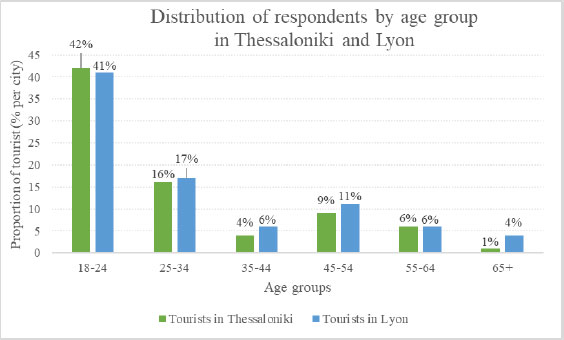
Distribution of tourist respondents by age group in Thessaloniki and Lyon.
Figures 4 and 5 show that most tourists reported feeling safe in both cities.
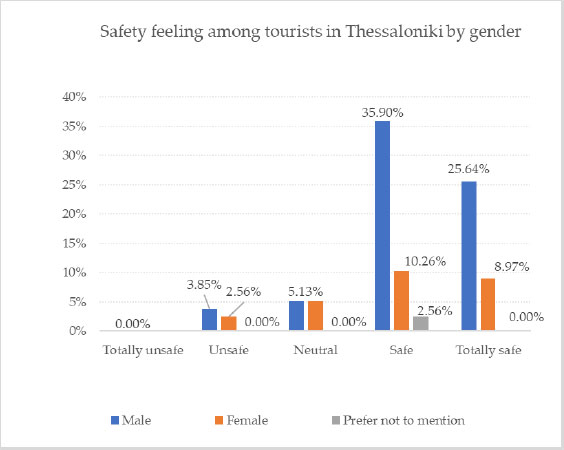
Safety feeling among tourists in Thessaloniki by gender (% represent proportions of the total city sample).
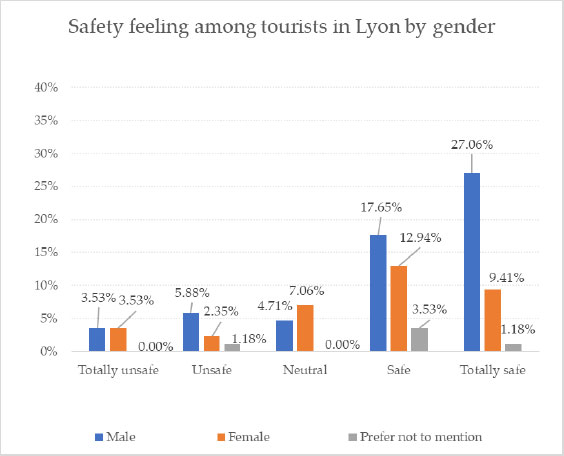
Safety feeling among tourists in Lyon by gender (% represent proportions of the total city sample).
Figure 4 indicates that the majority of tourists in Thessaloniki reported feeling safe or totally safe during their stay. Specifically, 35.9% of the total sample were male respondents who reported feeling “safe,” while 10.3% were female respondents reporting the same perception. Similarly, 25.6% of the total sample were men who felt “totally safe,” compared to 9.0% women. Neutral responses represented 5.1% of the total sample for each gender, while perceptions of being unsafe were relatively limited (3.9% men and 2.6% women). No respondents reported feeling “totally unsafe.” Overall, 83% of surveyed tourists in Thessaloniki reported feeling safe or totally safe during their stay.
Figure 5 indicates that perceptions of safety in Lyon were generally lower than in Thessaloniki. Specifically, 17.7% of the total Lyon sample were male respondents who reported feeling “safe,” while 12.9% were female respondents reporting the same perception. Similarly, 27.1% of the total sample were men who felt “totally safe,” compared to 9.4% women. Neutral responses were more frequent than in Thessaloniki (7.1% men and 4.7% women). Reports of feeling “unsafe” accounted for 5.9% of men and 2.4% of women, while 3.5% of both genders selected “totally unsafe.” Overall, 16% of respondents in Lyon expressed some degree of insecurity.
Through the following figure, it is shown that tourists in Lyon and Thessaloniki use many different means of transport (Fig. 6):
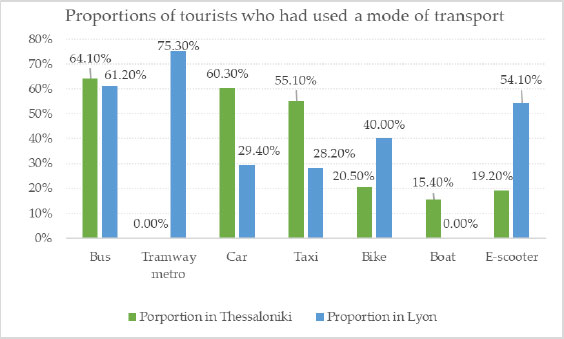
Proportions of tourists using different transport modes in Thessaloniki and Lyon.
Figure 6 shows that in Thessaloniki, the most frequently used transport modes among tourists are buses (64.1%), cars (60.3%), and taxis (55.1%), with no reported use of the metro or tramway. Bicycle use is 20.5% and e-scooter use is 19.2%, while boat use is limited to 15.4%. In Lyon, the tramway/metro (75.3%), buses (61.2%), and e-scooters (54.1%) dominate, followed by bicycles (40.0%), cars (29.4%), and taxis (28.2%), with no reported boat use. The high car usage in Thessaloniki is surprising for tourists but may be explained by travel beyond the city to the wider Region of Central Macedonia or across Greece. Affordable bus tickets and low taxi/Véhicule de Tourisme avec Chauffeur (VTC) prices, compared to those in many European countries, also make road-based modes of transportation attractive. In contrast, Lyon’s dense metro and tramway network, combined with efficient public transport and bike- and e-scooter-sharing systems like Vélo’v, reduces dependence on cars despite higher taxi and VTC costs.
3.2. CBC Results
Using the CBC analysis questions, the utility of the levels and the importance of the attributes could be determined.
Utility is the parameter that enables the ranking of levels of a given attribute. The higher the utility, the more preferred the level is. Conversely, the lower the utility, the less preferred the level is. However, a negative level does not mean it was disliked; it simply means it was less preferred than the others. The same is true for a positive value, which could be judged as less unfavorable than the other levels of each attribute.
The primary information of interest is the importance of each attribute. Attribute importance represents the impact that the attribute had on the respondent’s choices. This data allows for a direct comparison of the attributes.
The importance of the attributes in Thessaloniki is presented in Fig. (7) [RQ1]:
Figure 7 shows that in Thessaloniki, “green elements in the street and places” is the most important attribute for tourists, with an importance of 31.15%, far surpassing the other factors. This prominence is likely due to the city’s hot summer climate, with midday temperatures averaging 35 °C, making shaded and vegetated areas particularly valued. The next most important attributes are proximity of the public transport stop (18.56%) and equipment for crossing roads and safety (17.86%), followed closely by the number of obstacles on the sidewalk (16.61%) and weather protection (15.81%). The close values among these four suggest that, while greenery is a clear top priority, tourists also place nearly equal importance on safe, accessible, and obstacle-free walking.
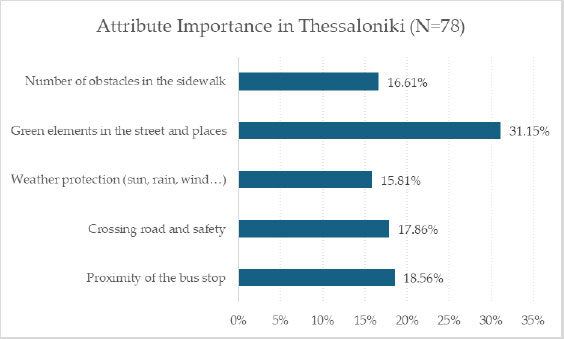
CBC relative importance of walkability attributes in Thessaloniki.
The importance of the attributes in Lyon is presented in Fig. (8) [RQ1]:
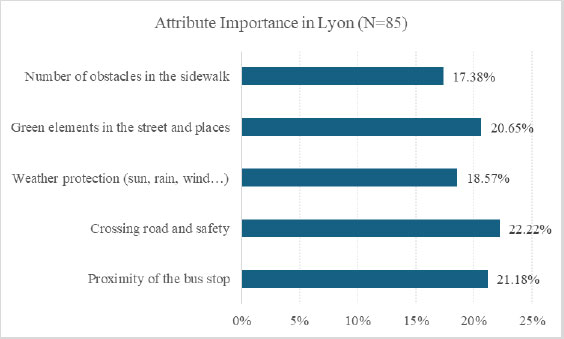
CBC relative importance of walkability attributes in Lyon.
Figure 8 shows that in Lyon, the five walkability attributes are rated more evenly than in Thessaloniki, with values ranging from 17.38% to 22.22%. The most important factors are equipment for crossing roads and safety (22.22%), followed closely by the proximity of the public transport stop (21.18%) and green elements in streets and public places (20.65%). Weather protection accounts for 18.57%, and the number of sidewalk obstacles ranks last at 17.38%. This balanced distribution indicates that tourists in Lyon consider various elements of walkability nearly equal, with a marginal inclination towards secure road crossings and accessible public transport.
4. DISCUSSION
Interpreting the results through the framework, we address [RQ1–RQ3] (within-city priorities, between-city differences, and trade-offs) and then discuss [RQ4] (transferability). The study’s findings align with accessibility and walkability theory: crossing quality and proximity to public transport influence route choice, while green spaces and shade serve as climate-sensitive comfort enhancers; between-city differences reflect contextual constraints.
Addressing RQ1–RQ3, we find that the greatest difference lies in the importance of green spaces in Thessaloniki, whereas this attribute ranks third in Lyon [RQ2]. This can be seen in the fact that Thessaloniki is a much warmer city, and, as mentioned earlier, green spaces create coolness within the urban fabric.
The city of Thessaloniki has little green space in its city center (Fig. 9), which is also near its center of activity attracting tourists, while in Lyon, there is not much green space in the city center either, but the rivers that run through the city help to cool the city down and provide plenty of space close to the city center where one cannot feel the heavy heat (Fig. 10).
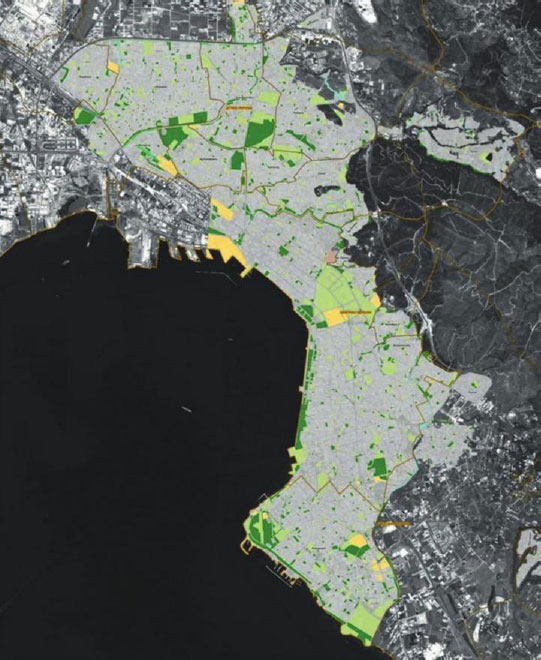
Green spaces in Thessaloniki [51].
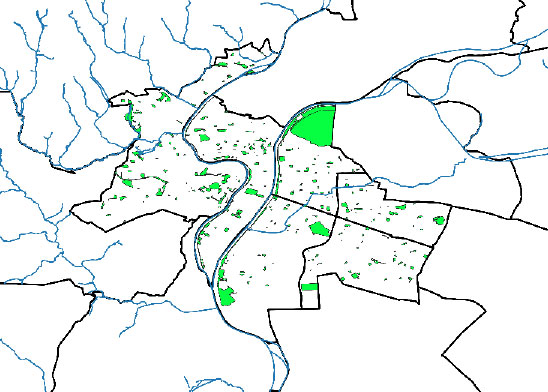
Spatial distribution of public parks and gardens within the municipality of Lyon [52].
It should be noted that the surveys in Lyon were conducted two weeks later than in Thessaloniki, in mid-August, when the weather was cooler in both cities. In addition, the summer of 2021 was particularly cool in France and in Lyon compared to the heat waves of previous years. This may have led people in Lyon to feel the heat less than usual.
The pronounced importance of green elements in Thessaloniki (31.15%) is consistent with research emphasizing the role of vegetation and microclimatic moderation in shaping pedestrian behavior under high-temperature urban conditions. Behavioral thermal regulation has been shown to significantly influence pedestrian path choices in hot environments, as individuals actively seek shaded and vegetated routes to minimize thermal discomfort [39]. Similarly, studies examining preferences for urban green infrastructure have demonstrated that tree canopy and natural elements substantially enhance perceived environmental quality and walking attractiveness [45]. Broader built-environment analyses further confirm that greenery and environmental comfort are central components of perceived walkability [38]. The study’s findings extend this literature by quantifying the magnitude of these preferences using CBC trade-offs, demonstrating that under Mediterranean summer conditions, greenery outweighs even accessibility and crossing safety in shaping tourist route choice.
The second most noticeable difference in the results is the importance tourists in Lyon attribute to traffic-related equipment, which received higher importance than all other attributes [RQ2]. This result was unexpected because pedestrian crossings are always marked on the ground in Lyon, unlike in Thessaloniki. Similarly, there are many traffic lights for safe road crossings. It is therefore worth considering why this result was obtained:
- It may be due to people’s behavior behind the wheel, driving faster or more aggressively, whether in cars, bikes, scooters, or electric scooters. So, tourists in Lyon would feel less safe.
- Conversely, it is possible that tourists in Lyon feel safer in traffic than in their place of origin. As a result, they would pay greater attention to unfamiliar situations and to those for which they have not developed appropriate habits.
The more balanced distribution of attribute importance observed in Lyon, with crossing safety ranking highest (22.22%), aligns with existing studies highlighting the critical role of intersection design, signalization, and perceived safety in pedestrian decision-making. Conjoint and modeling approaches have consistently shown that safety-related infrastructure and accessibility features significantly influence route preferences in urban contexts [36, 37]. Built-environment research further identifies crossing facilities and connectivity as foundational determinants of walkability in compact European cities [38]. From a tourism perspective, accessibility to destinations and integration with transport networks are key components of visitor mobility behavior [42]. The Lyon results, therefore, reinforce prior evidence suggesting that in temperate, well-connected cities, tourists evaluate walkability as a multi-dimensional construct in which safety and accessibility carry weight comparable to environmental comfort.
In both cities, the presence of pavement obstacles and the availability of weather shelter were ranked last and second-to-last [RQ3]. These results, therefore, indicate a lack of interest, or at least less interest, in these attributes compared to the others. Without a doubt, tourists and others often perceive these attributes as secondary or do not consider the possibility of a city where streets are blocked, and shelters are nonexistent. However, it is possible that some areas, such as Vieux Lyon, have no shelter from which to take refuge during a rainstorm. The same is true for pavements with obstacles.
Apart from the need for green spaces in Thessaloniki, we can see that tourists in both cities have similar needs, such as being close to public transport stops and having facilities for safe road crossing [RQ3].
The findings are most comprehensible when considered in relation to the conceptual frameworks outlined in the Introduction. Walking is the oldest and most accessible mode of transportation, and it is significantly influenced by urban design, local climate, and cultural perspectives. In this context, visitors in Thessaloniki exhibit a pronounced inclination towards green places. This corroborates prior research underscoring the importance of urban greenery for climate, environmental health, and psychological well-being. This is particularly evident in Mediterranean climates, where compact structures and insufficient shade exacerbate urban heat. The World Health Organization (2022) [47] underscores the importance of green, pedestrian-friendly landscapes for health and sustainability. The result confirms that green space is not merely a passive setting; it significantly influences mobility behavior, particularly in hot urban areas such as Thessaloniki. Such pedestrian-oriented urban interventions signify a shift toward integrating greener and more walkability-oriented approaches into public space design. Nonetheless, their efficacy for travelers depends on their accessibility and proximity to major tourist routes, as this study demonstrates.
In Lyon, the dominance of traffic safety infrastructure illustrates the relationship between perceived and actual safety and the urban experience. Despite Lyon’s superior pedestrian crossings and traffic signals compared to Thessaloniki, the persistent focus of tourists on this feature indicates that design alone does not ensure a perception of safety, particularly when vehicle conduct or the unfamiliarity of micromobility devices introduces an element of unpredictability. This supports Hall’s (1966) [11] cultural-anthropological argument that space is not neutral but is interpreted differently by users based on prior experience and cultural conditioning. What appears to be a well-designed crossing to a resident may still seem unsafe to a visitor from a quieter or more regulated pedestrian environment.
The findings further substantiate the notion presented in the Introduction that walkability is intricately connected to intermodality. Walking is an essential part of every trip, and efficient public transportation links enhance its appeal. The ranking of proximity to transport stops as second in both cities indicates that tourists appreciate the convenience and reassurance that alternative transportation offers while navigating new urban environments. This underscores the necessity for transport design that is accessible, coherent, and seamlessly integrated, as articulated in the “Accessibility and connectivity” section of the Introduction.
The lower rankings for weather protection and sidewalk obstacles, although uniform across cities, need attention. As explained in the Introduction, individuals generally observe these attributes just when they are deficient or malfunctioning. In cities with intermittent rainfall or harsh temperatures, the absence of shelter may seem less urgent under temperate conditions. Nevertheless, the comfort of tourists may be compromised under adverse conditions, so urban resilience planning must incorporate this consideration through meticulous design rather than merely reacting to criticism.
From a methodological standpoint, our study contributes to tourism and walkability research by operationalizing micro-scale street-level attributes within a comparative CBC framework. While tourism studies have widely applied choice experiments to examine residential redevelopment preferences, destination attributes, or niche tourism products [40, 41, 43], relatively few have modeled pedestrian route-level walkability determinants through trade-off-based experimental design. Furthermore, research linking tourism and walkability has often relied on aggregate indices such as Walk Score rather than behavioral preference modeling [44]. By applying identical randomized CBC experiments across two European cities, this study bridges transport behavior analysis and tourism mobility research, providing quantifiable and context-sensitive insights into how visitors prioritize safety, accessibility, greenery, and micro-impedances.
This paper further supports the human-centric social perspective presented in the Introduction. Hall (1966) [11] asserts that architects and urban planners will avoid disaster only if they regard humans as interlocutors with their environment. Tourists, as transient occupants of space, provide a distinctive viewpoint on a city’s walkability, free from habitual influences. In contrast to residents, they assess a location based on immediacy, clarity, comfort, and sensory perceptions. This provides essential insights into the factors that render a space welcoming or difficult to navigate.
From a broader planning perspective, these findings indicate a shift towards user-centered, evidence-based urban planning. They also validate the efficacy of Conjoint Analysis in uncovering latent preferences that may not be discernible through observation or hierarchical planning. This study prioritizes tourist perceptions, contrasting with earlier top-down pedestrian planning initiatives that often failed to sufficiently incorporate user perspectives.
Finally, it is important to note that although Thessaloniki and Lyon vary considerably in size, climate, and infrastructure, the analogous rankings of certain attributes (proximity of public transport stops and safety) suggest a common cross-cultural rationale for tourists’ preferences in walkable environments. Nonetheless, local particularities, such as temperature in Thessaloniki or traffic patterns in Lyon, might alter the relative significance of many characteristics. Urban planners should therefore seek to blend universal design principles with localized adaptation, especially when designing for short-term users, such as tourists [RQ4]. The comparative evidence supports RQ4 by distinguishing between priorities that are likely transferable (such as crossing quality and the proximity of the public transport stop) and those that are context-sensitive (such as green/shade intensity and obstacle mitigation).
Several limitations should be noted. First, the study’s findings are based on a relatively small, uneven sample of 163 respondents, limiting the extent to which the results can be applied broadly. Nevertheless, it is worth noting that in Conjoint Analysis, we do not expect a sample to be statistically significant in the same sense as in common polling exercises, as respondents provide multiple answers to the same CBC problem. Moreover, the tourist population is significantly lower compared to the resident population. Second, all data were gathered in the summer of 2021, which may not account for seasonal variations or post-pandemic changes in tourist behavior. Third, although Conjoint Analysis offers valuable insights into perceived preferences, it fails to assess real walking behavior or variables such as heat exposure and noise in urban environments. Ultimately, because the poll was administered exclusively to tourists, the findings cannot be extrapolated to the local population.
It is also important to acknowledge the temporal context of data collection. The surveys were administered during Summer 2021, when international tourism was gradually recovering from pandemic-related disruptions. Although major lockdowns had been lifted in both countries, residual health awareness and behavioral adaptations may have influenced preferences. For instance, heightened sensitivity to crowding and enclosed environments could partially explain the strong emphasis on green space and outdoor comfort, particularly in Thessaloniki. At the same time, the prominence of accessibility and structured infrastructure in Lyon may reflect a preference for predictability and organized public space during a period of gradual normalization of mobility. While it is difficult to isolate pandemic effects from structural urban characteristics, the temporal context likely interacted with environmental and climatic factors in shaping perceived walkability.
Future research could increase the sample size by including residents for comparison with tourists and integrate stated-preference methodologies with behavioral data, such as GPS tracking or ethnographic observation. While the present study adopts a multidisciplinary approach that integrates urban planning and behavioral insights, future research could be strengthened by involving a sociologist or social geographer with expertise in tourism. This would provide a more profound examination of tourists’ socio-spatial behaviors and cultural anticipations, therefore enhancing the understanding of walkability assessments and their contextual variability.
5. STUDY LIMITATIONS
Several limitations should be acknowledged when interpreting the findings of this study. First, the sample size (163 respondents) is relatively modest and unevenly distributed between the two cities. Although this is acceptable for CBC analysis, where each respondent provides multiple-choice observations, it still limits statistical generalizability beyond comparable tourist contexts.
Second, data collection took place exclusively during the summer of 2021. As a result, the findings primarily reflect warm-season conditions. They may overemphasize attributes related to thermal comfort (e.g., green elements and shade), while underrepresenting priorities that could emerge in colder or wetter seasons. Pandemic-related travel patterns at that time may have also influenced the demographic profile of respondents, notably the overrepresentation of younger tourists.
Third, the study relies on stated preferences rather than observed behavior. While CBC is well-suited to identifying trade-offs and relative attribute importance, it does not capture actual walking routes, exposure to environmental conditions, or real-time constraints. Consequently, the results reflect perceived rather than revealed behavior.
Fourth, the focus on tourists means that the findings cannot be extrapolated to residents, whose walking behavior is shaped by routine travel, local knowledge, and long-term exposure to the urban environment. Tourists evaluate walkability in terms of immediacy, clarity, and comfort, which differ fundamentally from those of commuters or residents.
Finally, although the selected attributes were intentionally limited to observable, design-actionable, and comparable factors, this necessarily excludes other potentially influential dimensions of walkability, such as noise, crowding, air quality, slope intensity, or social interactions. These omissions may partly explain the relatively balanced importance scores observed in Lyon.
Future research should expand the sample size, incorporate multiple seasons, include resident populations, and combine stated-preference methods with behavioral data (e.g., GPS tracking or systematic observation) to strengthen external validity and deepen understanding of tourists’ walkability experiences.
CONCLUSION
In this study, five attributes were selected as characteristics, and a quantitative research study, in the form of Conjoint Analysis, was conducted in both Thessaloniki and Lyon. The five characteristics that were chosen as most important were the following: 1) proximity of public transport stop: (i) < 5 min, (ii) 5-15 min, (iii) > 15 min; 2) equipment for crossing roads and safety: (i) traffic lights, (ii) pedestrian crossing, (iii) no traffic lights or pedestrian crossing; 3) weather protection: (i) totally covered, (ii) partially covered, (iii) uncovered; 4) green elements in the street and places: (i) vegetated, (ii) few plants, (iii) no green elements; 5) number of obstacles on the sidewalk: (i) no obstacles, (ii) few obstacles, (iii) obstacles.
Tourists in the two cities completed 163 questionnaires, with 78 in Thessaloniki and 85 in Lyon.
In Thessaloniki, the order of the attributes’ importance was found to be as follows: 1) green elements in the street and places: 31.15%, 2) proximity of public transport stop: 18.56%, 3) equipment for crossing roads and safety: 17.86%, 4) number of obstacles on the sidewalk: 16.61%, and 5) weather protection: 15.81% [RQ1].
In Lyon, the order of the attributes’ importance was found to be as follows: 1) equipment for crossing roads and safety: 22.22%, 2) proximity of public transport stop: 21.18%, 3) green elements in the street and places: 20.65%, 4) weather protection: 18.57%, and 5) number of obstacles on the sidewalk: 17.38% [RQ1].
Many interesting results were derived from comparing tourists’ perceptions of walkability in the two cities, and even more from comparing the utility of each level for each attribute.
The population has neglected walking for many years in favor of ever-faster, simpler modes of transportation. However, as cities’ collective environmental awareness has increased, actions have been taken to promote walking once again. However, for this to happen, it is necessary to consider the needs and expectations of pedestrians and potential pedestrians who will use the public space facilities.
The walkability of a place depends on many factors, and population surveys help us learn about people’s priorities. As a result, urban and transportation planners can consider various parameters, such as safety, sensory well-being, tree cover, attention to the aesthetics of the surroundings, and ease of movement, at different scales.
Through this study, we observed trends among tourists, finding similar expectations in the cities of Thessaloniki and Lyon, and noting a significant attachment to green spaces in the Greek city. We can assume that this attachment is due to the city’s climate and the development of green areas.
In another study, one might expect the results for the inhabitants of these cities to vary across cities. Tourists’ expectations are linked to the habits they have acquired in their home countries. Tourists are a population that visits the city for a relatively short period, walks around, and have cultural needs different from those of those who live in the city.
Tourist cities, such as Thessaloniki and Lyon, must ensure their spaces are well walkable for both travelers and residents. To achieve this, they must reconcile the expectations of each group without abandoning any population [RQ4].
Given the prominence of green elements in Thessaloniki (31.15% relative importance), urban interventions should prioritize microclimatic enhancements along pedestrian routes. This includes increasing tree canopy coverage along key tourist corridors, installing lightweight shading structures in exposed segments of the waterfront and central streets, and integrating small-scale green infrastructure (e.g., pocket parks, planted corridors). Given the Mediterranean summer context, such interventions may yield immediate improvements in pedestrian comfort and tourist satisfaction. Additionally, maintaining clear, obstacle-free sidewalks in high-tourism zones should remain a secondary yet consistent priority, ensuring accessibility for all user groups.
In Lyon, where crossing safety emerged as the most important attribute (22.22%), policy efforts should focus on intersection-level improvements. This includes enhanced pedestrian signal timing, raised crossings in mixed-traffic areas, improved visibility at junctions, and traffic-calming measures in tourist-dense corridors. Given the balanced importance of attributes, integrated pedestrian planning, combining safe crossings, multimodal connectivity, and clear wayfinding, appears more appropriate than single-attribute interventions.
This paper presents an applied, comparative CBC of tourists’ walkability preferences across two European cities that differ in climate, multimodal network maturity, and baseline green infrastructure. By estimating relative attribute importances and level utilities, we quantify trade-offs among four design-actionable, observable attributes, i.e., crossing equipment/markings, proximity of the public transport stop, green/shade, and obstacles, plus weather protection. Two findings are transferable to similar European urban contexts: (i) upgrading crossing quality/legibility and (ii) ensuring nearby public transport access consistently emerge as top priorities.
Context-sensitive levers should then be calibrated to local conditions: in warmer climates and sun-exposed corridors, green/shade and weather protection become more salient; where micromobility/traffic complexity is higher, crossing treatments predominate. In practice, cities can phase investments by first addressing crossings and public transport proximity along priority tourist corridors, and then tuning shade/obstacle mitigation to their climatic and street-morphology profiles.
AUTHORS’ CONTRIBUTIONS
The authors confirm contribution to the paper as follows: D.N.: conceptualization, methodology, supervision, study design, development of the methodological framework, formal analysis, interpretation, writing—original draft, and writing—review and editing; L.L.: investigation, data collection, formal analysis, and interpretation; V.M.: writing—review and editing, critical review, and expert input on transportation engineering and mobility; E.A.: writing—review and editing, critical review, and expert input on policy implications and planning. All authors read and approved the final manuscript.
LIST OF ABBREVIATIONS
| CBC | = Choice-Based Conjoint |
| DCE | = Discrete Choice Experiment |
| GPS | = Global Positioning System |
| PWD | = People With Disability |
| RP | = Revealed Preference |
| RQ | = Research Question |
| SP | = Stated Preference |
| VTC | = Véhicule De Tourisme Avec Chauffeur |
ETHICS APPROVAL AND CONSENT TO PARTICIPATE
The study involved anonymous, non-interventional surveys of adult participants. No directly identifiable personal data was collected. Under the applicable institutional requirements of Aristotle University of Thessaloniki, formal approval by the Research Ethics Committee was not required; therefore, no approval or reference number was issued.
HUMAN AND ANIMAL RIGHTS
All human research procedures followed were in accordance with the ethical standards of the committee responsible for human experimentation (institutional and national), and with the Helsinki Declaration of 1975, as revised in 2013.
CONSENT FOR PUBLICATION
Informed consent was obtained from all the participants before enrolling them in the study.
AVAILABILITY OF DATA AND MATERIALS
The anonymized data supporting the findings of this study are available from the corresponding author [D.N.], upon reasonable request.
CONFLICT OF INTEREST
Dr. Dimitrios Nalmpantis is an Editorial Advisory Board Member for The Open Transportation Journal.
ACKNOWLEDGEMENTS
Declared none.